
Sarah Robertson ‘10
Math and Pre-Med
Where did you intern this summer?
This summer I worked at the Centers for Disease Control and Prevention in Atlanta, GA.
How did you find this internship?
I knew a few family friends who worked there. I spoke with them about their work, and I asked if they had any positions. I sent my resume in, and after answering a few of their questions they searched for an opening in my interest. They had a position, and I started working at the CDC.
How would your typical day go?
I would get in at 9 AM and go through security. In the morning I would work on my own projects. After lunch, we would have a group meeting where we discussed world events, their possible impact on public health, their prevalence to CDC, and if they should appear in our daily report. After these meetings I would either help compile the information from the meeting’s discussion into the next day’s report, or I would continue work on my projects.
What was your most interesting project?
I ran statistical analysis to determine the sound level differences in calls to the CDC. I found a correlation between the mainstream media reporting of a possible health emergency to the hotline traffic and caller noise level; one such example was the Tollhouse Cookie Dough incident over the summer. The mainstream media tended to be 2-3 days behind reporting on the incident than when our group in CDC became aware of the incident. I also helped to create a prediction of the number of H1N1 calls for this fall.
What advice do you have for others seeking internships?
Use whatever connections you have. Be polite and professional in any and all correspondence and answer emails promptly.
What were the other highlights of your summer experiences?
I had the opportunity to tour the Emergency Operation Center at the CDC’s main campus. I was also allowed to sit in on, via video feed, the CDC director’s weekly briefing of H1N1.
Showing posts with label science. Show all posts
Showing posts with label science. Show all posts
Wednesday, September 23, 2009
Wednesday, May 20, 2009
“NASA’s Return to the Moon” with Dr. Christopher J. Wohl
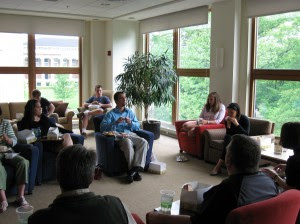
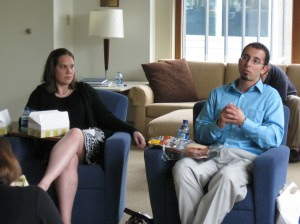
Friday May 15, Dr. Christopher J. Wohl visited Washington and Lee students from the NASA Langley Research Center in Hampton, Virginia. Dr. Wohl gave a lecture with W&L science majors before attending a Career Services sponsored lunch with a group of students and professors. Afterward, Dr. Wohl made himself available for meetings with individual students in the Career Services office.
The sciences attracted Dr. Wohl’s curiosity from an early age. As a young child, he enjoyed mixing concoctions of juice together and seeing them separate and balance out over time. Upon graduating from high school, he attended a local community college before transferring to Virginia Tech. He recounted that the sciences were his clear strength, and he often encountered trouble in other disciplines. Nonetheless, he stressed the importance of interdisciplinary skills, namely writing, in his scientific work both as a student and as a professional. After graduating from Tech, he enrolled the PhD. program at Virginia Commonwealth University. There he exhibited an outstanding record, earning his Doctorate of Philosophy in three and a half years with a 4.0 GPA. This academic achievement far surpassed VCU’s averages for the PhD.
After completing his studies, Dr. Wohl took on a job at the NASA Langley Research Center in Hampton, Virginia. He noted that NASA’s most significant test right, with regard to space exploration, is economic efficiency and commerce. NASA is brainstorming possible ways that colonies or pit stops on the moon or Mars could make space exploration commercially profitable and more efficient. Launch sites with lower gravity and less atmosphere would save substantial rocket fuel. In addition, moon factories with low gravity could naturally do away with vastly expensive machines that replicate such gravitational conditions on Earth.

Dr. Wohl also spoke to many students’ the coming tests in the job search. He stressed communication in all forms. “In every position,” he said, “communication is key; if you can’t communicate your ideas correctly, you can’t get people to buy into your ideas.” Dr. Wohl especially stressed writing and public speaking. He offered several suggests for improving one’s public speaking abilities. Observation and imitation of skilled speakers provides a strong model. Practice develops one’s speaking skills. His best form of practice entails coming home from work and explaining his day at NASA to his wife. He believes that if he can make his wife (who has little background in science) understand what he’s working on, then he has done an effective job communicating.
Dr. Wohl provided an informative perspective for NASA’s move into the 21st Century and a great account of a student’s move into the job force.
The sciences attracted Dr. Wohl’s curiosity from an early age. As a young child, he enjoyed mixing concoctions of juice together and seeing them separate and balance out over time. Upon graduating from high school, he attended a local community college before transferring to Virginia Tech. He recounted that the sciences were his clear strength, and he often encountered trouble in other disciplines. Nonetheless, he stressed the importance of interdisciplinary skills, namely writing, in his scientific work both as a student and as a professional. After graduating from Tech, he enrolled the PhD. program at Virginia Commonwealth University. There he exhibited an outstanding record, earning his Doctorate of Philosophy in three and a half years with a 4.0 GPA. This academic achievement far surpassed VCU’s averages for the PhD.
After completing his studies, Dr. Wohl took on a job at the NASA Langley Research Center in Hampton, Virginia. He noted that NASA’s most significant test right, with regard to space exploration, is economic efficiency and commerce. NASA is brainstorming possible ways that colonies or pit stops on the moon or Mars could make space exploration commercially profitable and more efficient. Launch sites with lower gravity and less atmosphere would save substantial rocket fuel. In addition, moon factories with low gravity could naturally do away with vastly expensive machines that replicate such gravitational conditions on Earth.
Dr. Wohl also spoke to many students’ the coming tests in the job search. He stressed communication in all forms. “In every position,” he said, “communication is key; if you can’t communicate your ideas correctly, you can’t get people to buy into your ideas.” Dr. Wohl especially stressed writing and public speaking. He offered several suggests for improving one’s public speaking abilities. Observation and imitation of skilled speakers provides a strong model. Practice develops one’s speaking skills. His best form of practice entails coming home from work and explaining his day at NASA to his wife. He believes that if he can make his wife (who has little background in science) understand what he’s working on, then he has done an effective job communicating.
Dr. Wohl provided an informative perspective for NASA’s move into the 21st Century and a great account of a student’s move into the job force.

Subscribe to:
Posts (Atom)